Evaluating AI Agents: Moving Beyond the Vibe Check with Systematic Testing
Moving from subjective evaluation to systematic, continuous automated testing pipelines for multi-turn AI agents using Google's reference architecture.
Evaluating AI Agents: Moving Beyond the Vibe Check with Systematic Testing
Moving from subjective evaluation to systematic, continuous automated testing pipelines for multi-turn AI agents using Google's reference architecture.
Quick Summary
- Google published an engineering guide and reference architecture for continuous evaluation pipelines for multi-turn AI agents.
- The guide details methods to move past manual vibe checks into systematic, automated verification.
- Core tooling and standards discussed include the Gemini Enterprise Agent Platform, Google ADK, and OpenInference.
What Changed?
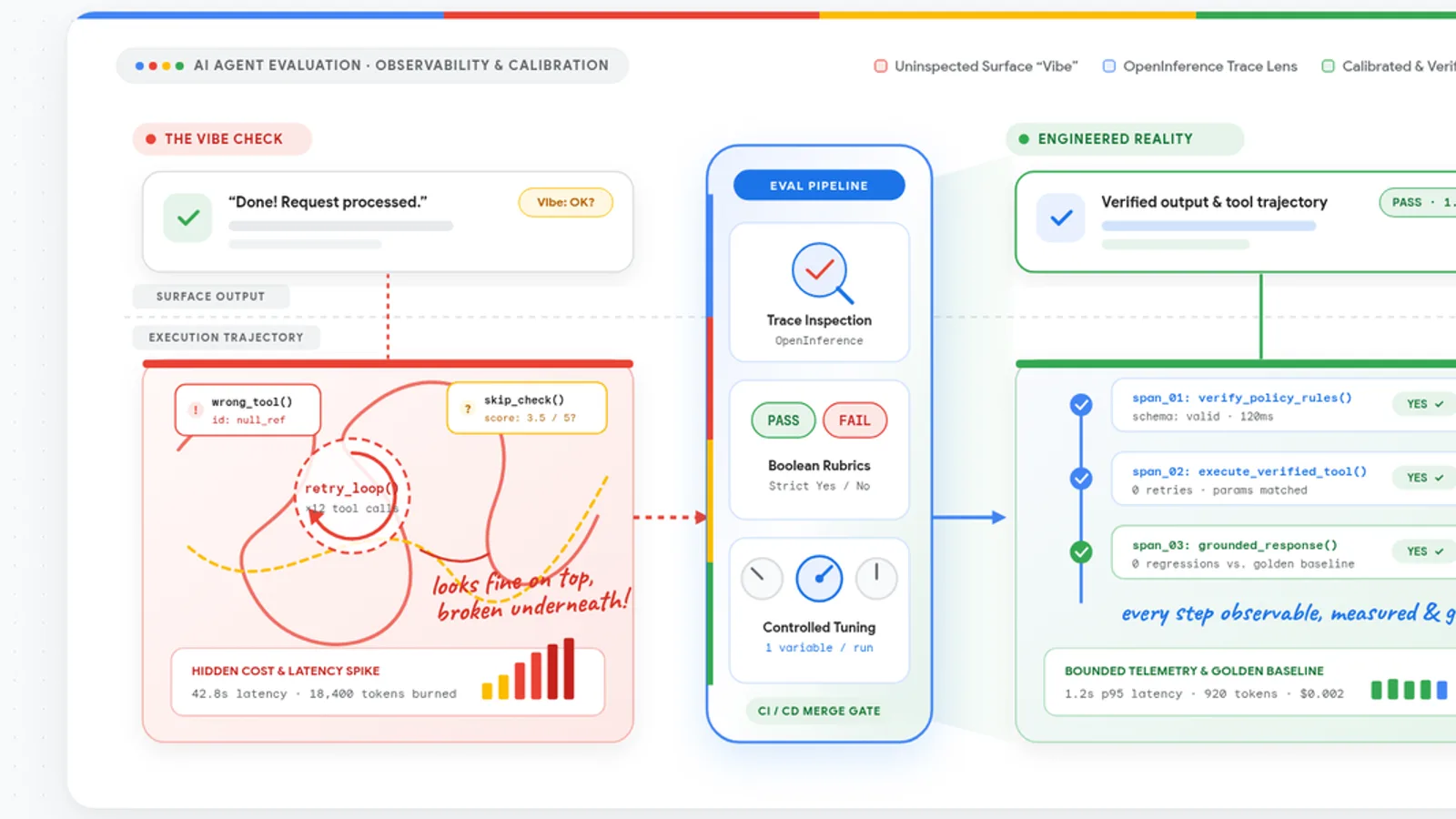
The release on the Google Developers Blog provides a formal reference architecture for agent evaluation. Historically, developers relied heavily on manual testing, often called vibe checks, to assess how a language model responded to conversational tweaks. This informal approach fails at scale, particularly for multi-turn agents where state changes across multiple dialogue steps. The newly detailed approach integrates specific platforms and standards—namely the Gemini Enterprise Agent Platform, Google ADK, and OpenInference standards—to provide structured observability and verification mechanisms for complex agent workflows.
Technical Breakdown
Multi-turn AI agents introduce distinct architectural challenges compared to single-shot text generation. Because agent outputs depend on stateful, sequential interactions, a failure in turn two can cascade through the entire workflow. To evaluate these systems continuously, pipelines must capture telemetry tracing at each step of the dialogue tree. As noted in the architectural framework, OpenInference standards are utilized for tracing and observing application executions, enabling debugging and quantitative assessment. By combining these telemetry traces with execution environments provided by the Google ADK and Gemini Enterprise Agent Platform, engineering teams can inspect tool calls, reasoning steps, and state transitions against expected reference behaviors.
Practical Advice
For teams building production systems, transitioning away from manual prompt evaluation requires a methodical overhaul of deployment pipelines. Start by identifying user journeys and capturing multi-turn interaction logs to serve as regression test fixtures. Instrument agent applications using OpenInference-compliant tracing to ensure execution steps are captured during test runs. Integrate these test suites into automated deployment pipelines using the Google ADK and Gemini Enterprise Agent Platform primitives, setting deterministic assertion thresholds where possible and semantic similarity benchmarks for conversational variations.
Limitations
Automated agent evaluation remains an evolving discipline with notable boundaries. Non-deterministic model outputs mean that identical test inputs can yield divergent reasoning paths, complicating pass/fail assertions. Running comprehensive multi-turn evaluation suites across large test sets introduces substantial compute and API costs. There is currently a scarcity of universal benchmark datasets tailored to specific enterprise domains, meaning teams must invest engineering effort into curating custom evaluation suites for their specific agent workflows. Specific implementation details, code examples, and architectural diagrams from the guide are not captured in the short summary metadata, and the exact publication date of the blog post is not specified in the source metadata.
CodePlay Developer Take
From a development perspective, adopting a structured evaluation framework transforms agent reliability from an unpredictable guessing game into a measurable software engineering discipline. When teams rely on subjective testing, regressions hide silently behind prompt updates. By codifying expected agent behavior into automated pipelines using established standards like OpenInference, developers gain the telemetry necessary to isolate whether a failure stems from model drift, tool integration errors, or faulty state management.
CodePlay Verdict
Enterprise engineering leaders should view continuous evaluation not as an optional polish phase, but as a hard prerequisite for multi-turn agent deployment. Utilizing reference architectures like those outlined by Google provides a viable roadmap to tame agent non-determinism. Investing in automated testing pipelines prevents costly production failures and establishes the necessary baseline for scalable AI development.
Sources & Further Reading
- Evaluating AI agents: moving past the vibe check — primary source
Sources & Further Reading
CodePlay Insights references primary sources. Original reporting and announcements belong to their publishers.