Google's adk-recipes Repository: A Guide to the Three-Layered ADK Architecture
Google's adk-recipes repository introduces a three-layered architectural approach to standardizing Agent Development Kit resources.
Google's adk-recipes Repository: A Guide to the Three-Layered ADK Architecture
Google's adk-recipes repository introduces a three-layered architectural approach to standardizing Agent Development Kit resources.
Quick Summary
- Google published the google/adk-recipes repository to serve as a single source of truth for Agent Development Kit resources.
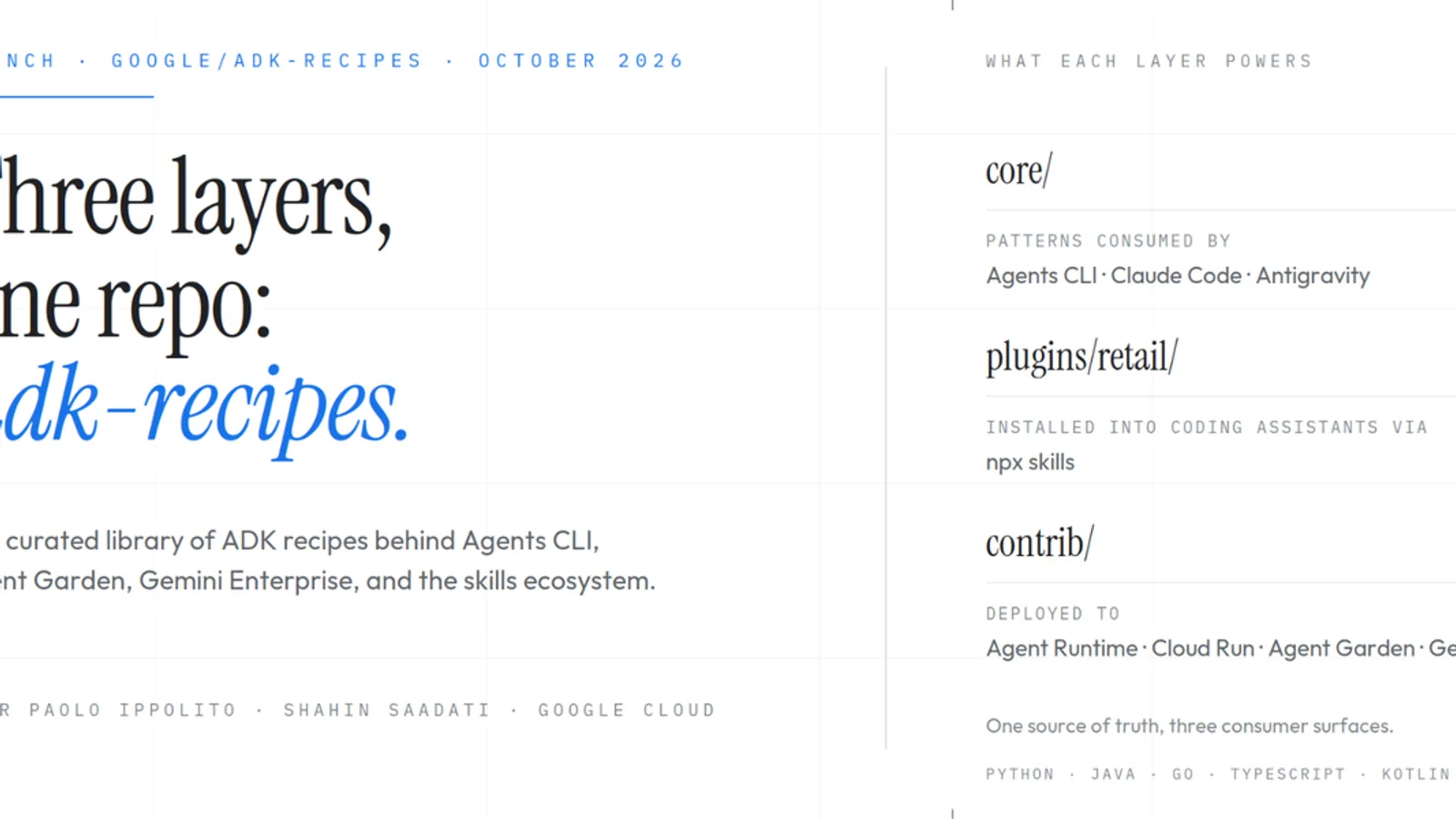
- The repository establishes a structured, three-layered layout using core/, plugins/, and contrib/ directories.
- Developers can use reference patterns and modular vertical skills such as retail product search and virtual try-on.
- The design aims to streamline production scoping and support multi-language service deployments.
What Changed?
Google released the unified adk-recipes repository to address the fragmentation often found in AI agent engineering. Historically, building production-ready agents required scattering foundational frameworks, utilities, and experimental features across disparate codebases. The core intent of this release is to provide a single source of truth that houses Agent Development Kit (ADK) resources under one roof, creating an organized environment for developers building modern AI applications.
Key Details
The repository is organized around three primary directories: core/, plugins/, and contrib/. The core/ directory houses foundational logic, while plugins/ and contrib/ provide extension points for modular functionality and community or experimental contributions. Developers can install modular vertical skills directly into coding assistants. Confirmed examples of these vertical skills include retail product search and virtual try-on capabilities, demonstrating how domain-specific features integrate into the overarching architecture.
Technical Impact
From a technical perspective, the repository employs a monorepo pattern ("one repo") to manage the lifecycle of AI agent software. Organizing code into core logic, extension plugins, and contribution tiers establishes strict architectural boundaries. This separation prevents tight coupling between foundational orchestration engines and domain-specific features. Modular vertical skills can thus be developed, tested, and maintained independently while still benefiting from shared runtime primitives defined in the core layer.
What This Means for Businesses
For organizations building AI-driven solutions, structured repositories reduce the friction associated with scoping and scaling agentic workflows. Standardizing on a unified layout streamlines the transition from initial project scoping to production-ready deployments. The repository's support for multi-language service delivery helps engineering leadership align disparate team skill sets around a common architectural standard, cutting down onboarding time and reducing long-term maintenance overhead.
Developer Impact
Day-to-day coding practices benefit directly from established reference patterns and reusable modular components. Instead of building vertical capabilities like retail product search or virtual try-on from scratch, developers can pull pre-structured patterns into their workflows and coding assistants. This modularity allows engineers to focus on business logic and agent reasoning behavior rather than boilerplate infrastructure setup.
Limitations
Analysis of the repository indicates several areas requiring caution. While developers can integrate patterns into assistants, claims regarding integration into specific third-party coding assistants require direct verification against evolving repository documentation. The source material does not detail the exact release timeline, comprehensive technical specifications for every layer, or an enumerated list of all supported programming languages for production deployment.
CodePlay Developer Take
Adopting a structured, multi-layered approach to agent development is essential as AI systems grow beyond simple prompt-response loops. The core/plugins/contrib paradigm provides a clean separation of concerns that mirrors mature software engineering practices. For teams building scalable applications, treating agent recipes as first-class, version-controlled architecture prevents technical debt and ensures that domain-specific skills remain decoupled from core orchestration runtimes.
CodePlay Verdict
Google's adk-recipes repository offers a pragmatic blueprint for structuring AI agent projects. By combining foundational logic with modular vertical skills in a monorepo format, it addresses critical scalability and maintainability challenges. We recommend reviewing the repository layout to establish consistent architectural boundaries for your next agentic deployment.
Sources & Further Reading
- Three layers, one repo: a tour of google/adk-recipes — primary source
Sources & Further Reading
CodePlay Insights references primary sources. Original reporting and announcements belong to their publishers.