Google Open-Sources AQuA: Diagnosing Production AI Agent Failures
Google has open-sourced AQuA, a reference implementation addressing silent production failures in AI agents through automated outer-loop diagnosis.
Google Open-Sources AQuA: Diagnosing Production AI Agent Failures
Google has open-sourced AQuA, a reference implementation addressing silent production failures in AI agents through automated outer-loop diagnosis.
Quick Summary
- Google announced the open-sourcing of AQuA (Ambient Quality Agent) as a reference implementation for Google Cloud.
- The tool targets silent quality regressions where AI agents fail semantically while returning successful HTTP 200 OK status codes.
- AQuA automatically sweeps failure clusters against conversation transcripts and anchors root causes to deployed source snapshots.
What Happened?
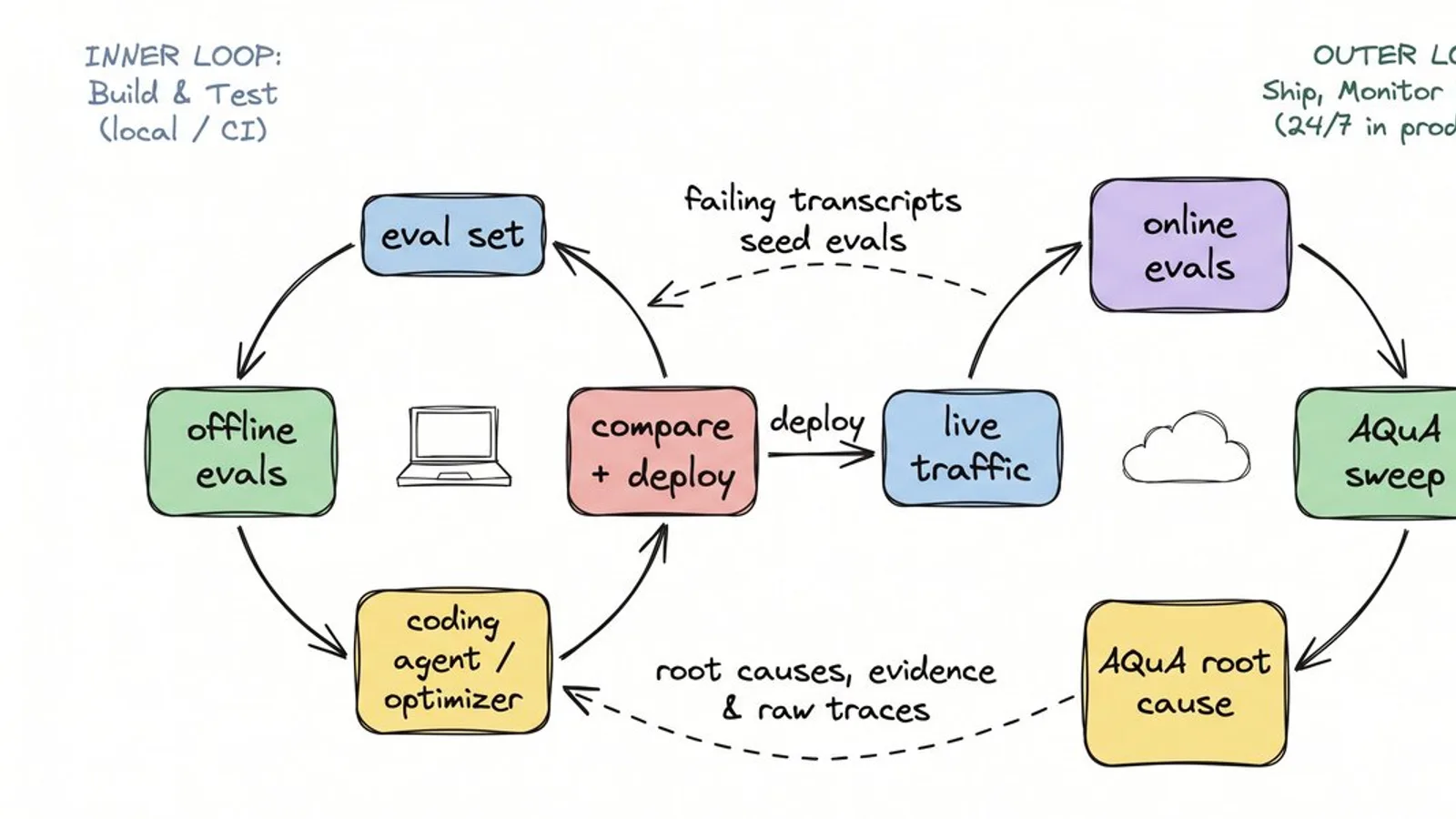
Google detailed the release of AQuA to assist engineering teams managing production AI systems. In traditional software development, infrastructure monitoring easily captures hard crashes and network errors. However, generative AI agents introduce a distinct failure mode: semantic degradation. An agent can completely miss user intent, hallucinate tool calls, or provide incorrect guidance while technically returning a standard HTTP 200 OK status. AQuA operates in this outer loop of development, shifting the focus from inner-loop code testing to continuous production diagnosis.
Key Details
The architecture of AQuA centers on systematic observation and root-cause analysis. According to the announcement, the system continuously sweeps and verifies failure clusters by evaluating them against historical conversation transcripts. Rather than leaving developers to manually parse thousands of chat logs to find out where an agent went wrong, AQuA automates the grouping of related errors. It anchors these identified root causes back to the exact deployed source snapshot, bridging the gap between runtime agent behavior and the specific version of the code that generated the response.
Developer Impact
Engineering teams deploying multi-step autonomous agents frequently struggle with debugging non-deterministic failures. When an agent drifts off track across a multi-turn conversation, isolating the prompt structure, tool definition, or logic flaw takes hours of manual inspection. Automating failure cluster sweeps allows developers to triage systemic regressions much faster. By tying errors directly to source snapshots, teams can verify whether a recent commit introduced a subtle semantic regression.
What This Means for Businesses
For businesses scaling AI agent deployments, silent failures represent a direct risk to user trust and retention. Because these failures do not throw server errors, they often go unnoticed until end users experience broken workflows or incorrect information. Mitigating these regressions protects brand reputation and reduces the operational overhead of manual customer support interventions. Automated diagnostic tooling helps organizations maintain consistent service quality as underlying agent logic and prompt configurations evolve.
Limitations
The initial announcement lacks granular documentation regarding specific architectural prerequisites, local codebase requirements, and integration steps outside of Google Cloud. Exact release timelines and licensing details were not fully detailed in the primary source material. Organizations evaluating AQuA should expect to invest time in understanding how the reference implementation maps to existing deployment pipelines and cloud infrastructure.
CodePlay Developer Take
Implementing post-deployment verification loops is an operational necessity for teams moving multi-step agents into production. AQuA highlights the industry shift toward treating agent observability as a continuous background process. For developers, the core value lies in the automated correlation between conversation transcripts and source code versions. Without this linkage, debugging non-deterministic agent outputs remains an exercise in guesswork. AQuA provides a concrete reference model for structuring this outer feedback loop.
CodePlay Verdict
Technical leaders currently struggling with production observability for non-deterministic AI agents should examine AQuA's reference implementation. While integration overhead and cloud dependencies require careful scoping, the focus on automated root-cause anchoring addresses a gap in modern LLM operations. We recommend reviewing the Google Developers Blog post to assess how its outer-loop evaluation model aligns with your current deployment architecture.
Sources & Further Reading
Sources & Further Reading
CodePlay Insights references primary sources. Original reporting and announcements belong to their publishers.