Routing Tasks Across Gemini Models With Lightweight Classifiers
Engineering teams scaling autonomous coding workflows can utilize lightweight classifiers to intelligently route tasks across Gemini models and thinking levels, balancing cost efficiency against execution performance.
Routing Tasks Across Gemini Models With Lightweight Classifiers
Engineering teams scaling autonomous coding workflows can utilize lightweight classifiers to intelligently route tasks across Gemini models and thinking levels, balancing cost efficiency against execution performance.
Quick Summary
- Per-token API prices are falling, yet total engineering bills for autonomous coding agents continue to climb.
- Model routing uses lightweight, low-cost classifiers to evaluate incoming tasks and allocate them efficiently.
- Tasks can be directed to smaller models or specific reasoning tiers within larger models depending on complexity.
- Dynamic task distribution helps mitigate runaway API expenditure in high-frequency agentic pipelines.
What Changed?
A distinct economic paradox has emerged in AI-assisted software engineering. Individual API calls are more affordable than ever on a per-token basis. Autonomous coding agents frequently generate massive volumes of tokens through iterative loops, reasoning steps, and self-correction cycles. Engineering budgets are straining under the weight of high-frequency agentic execution. The core issue is over-provisioning: utilizing top-tier reasoning models and maximum thinking levels for routine, deterministic operations like formatting strings, parsing logs, or generating boilerplate code. Solving this economic mismatch requires shifting from static model selection to dynamic, intent-aware task allocation.
Key Details
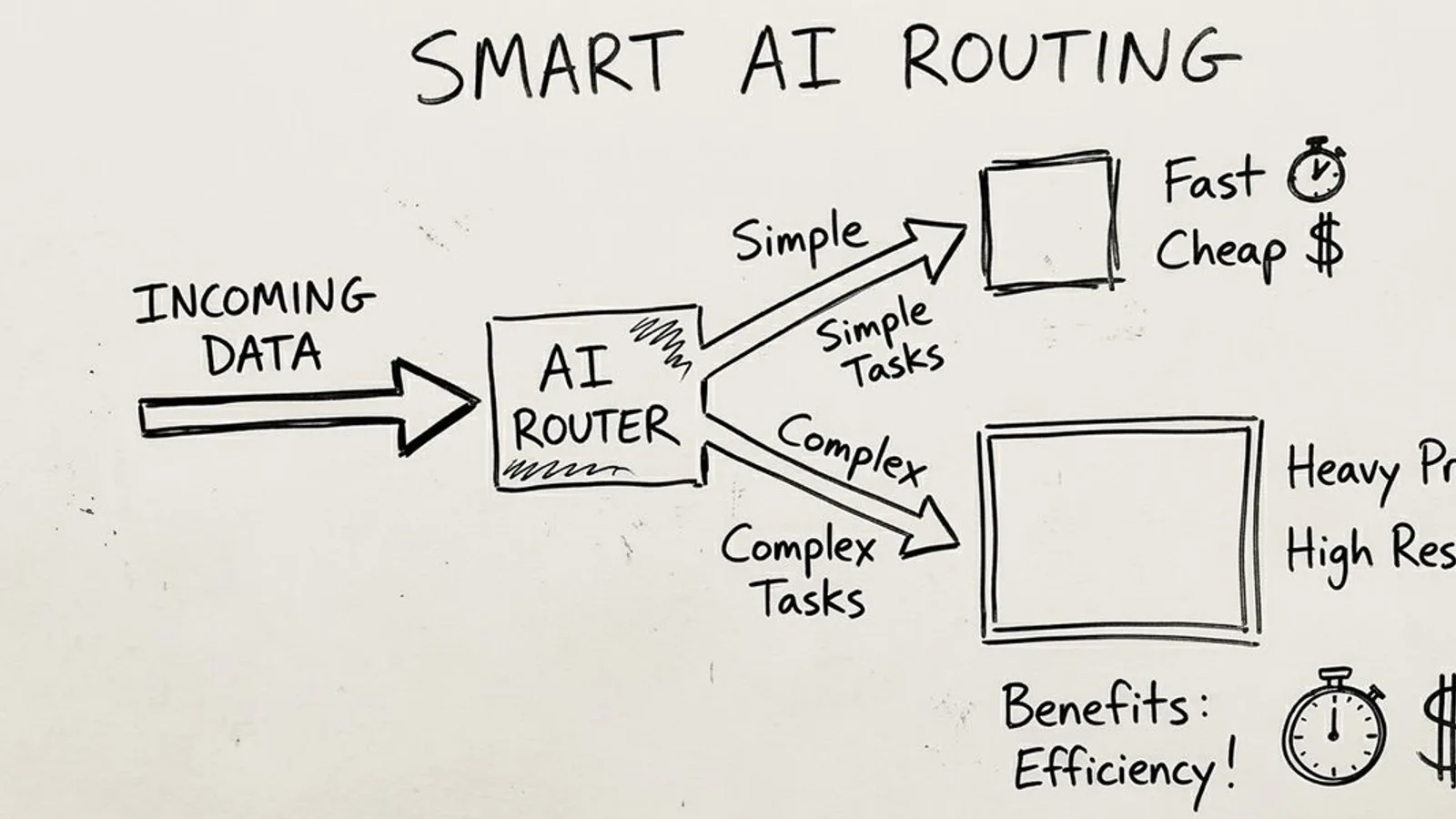
Model routing addresses the cost-performance dilemma by interposing a fast, inexpensive classifier ahead of the primary execution engine. According to guidance outlined on the Google Developers Blog, this approach evaluates incoming tasks before they reach primary models like Gemini. The classifier assesses the semantic complexity, structural requirements, and expected reasoning depth of the prompt. Based on these criteria, the task is directed either to a smaller, highly efficient model or to a specific thinking and reasoning level within a larger model. Simple utility functions bypass heavy reasoning tiers entirely, reserving high-cost compute exclusively for complex architectural decisions and debugging loops.
Technical Impact
From a system architecture perspective, introducing a routing layer requires balancing classifier overhead against downstream savings. A plain technical explanation of this workflow involves a three-step pipeline: ingestion, classification, and execution. The classifier must execute with minimal latency to avoid adding noticeable delay to the overall transaction. If the classifier is too complex, its own compute cost negates the savings; if it is too simple, misclassifications will route complex tasks to underpowered models. Designing this architecture means defining clear boundaries for what constitutes a low-complexity task versus a high-reasoning requirement, ensuring that the Gemini model and thinking level assigned match the actual technical demands of the code generation task.
What This Means for Businesses
For organizations scaling autonomous software development workflows, API cost predictability is essential for maintaining healthy profit margins. Unchecked agentic loops can quickly drain operational budgets, making ROI difficult to calculate. Implementing classifier-based routing introduces a financial control valve into the development stack. By ensuring that every prompt is processed at the lowest viable economic tier, organizations can scale their usage of autonomous coding assistants across larger engineering teams without linear cost scaling. This transforms AI tooling from a variable financial risk into a predictable, optimized operational expense.
Developer Impact
Engineering teams can implement routing logic into existing pipelines to optimize execution without degrading output quality. When configuring autonomous agents, developers should establish routing policies that separate deterministic tasks—such as linting checks, import sorting, and basic refactoring—from non-deterministic tasks requiring deep architectural reasoning. By integrating a lightweight classification step into the agent orchestration framework, developers can programmatically dictate when a Gemini model should engage deep thinking levels and when a faster, lighter configuration is sufficient. This maintains code quality while keeping feedback loops fast and economical.
Limitations
While the routing concept is sound, several uncertainties and risks remain. Specific classifier architectures and exact implementation blueprints are not detailed in initial summaries, requiring teams to design their own evaluation heuristics. Exact pricing tiers and latency impacts are currently unquantified in available source material. A primary risk is misclassification cascading into downstream failures: if a classifier incorrectly routes a complex architectural refactoring task to a lightweight model, the resulting code errors can trigger expensive retry loops, ultimately negating the intended cost savings.
CodePlay Developer Take
From a development perspective, dynamic model orchestration is the natural maturation point for agentic workflows. Treating all tasks with uniform compute power is an early-stage inefficiency that teams must eliminate as agents handle heavier production workloads. Building reliable routing logic requires rigorous telemetry. Engineering teams must measure classification accuracy and fallback success rates continuously. Without proper monitoring, routing layers can introduce silent failure modes where agents perform poorly due to under-allocation rather than inherent model limitations.
CodePlay Verdict
Classifier-based routing is an architectural pattern for teams serious about scaling autonomous coding agents sustainably. Organizations should begin by auditing their agentic workloads to identify routine tasks suitable for smaller Gemini tiers before deploying automated classifiers in production.
Sources & Further Reading
Sources & Further Reading
CodePlay Insights references primary sources. Original reporting and announcements belong to their publishers.